
Publication date: April 17 2026
Mapping is at the heart of many drone missions. Whether you’re documenting the progress of a construction site, surveying a solar farm or planning a precision agriculture treatment, accurate maps allow you to make informed decisions and provide your clients with powerful insights. In this post, we explain the core mapping deliverables—orthomosaics, digital elevation models and 3D models—before exploring how LiDAR enhances your data. We’ll also share best practices for achieving survey‑grade results and show how Blue Nose Aerial Imaging uses these techniques to deliver value for our clients.
What is drone mapping?
At its simplest, drone mapping involves flying a small unmanned aircraft over an area and taking a series of overlapping photographs. Photogrammetry software processes those images, correcting lens distortions and aligning them with precise ground coordinates. The result is a set of georeferenced data products that can be used for measurements and analysis.
Unlike satellite imagery, drone mapping offers a high level of detail (centimeter‑level resolution is common) and can be scheduled on your timeline. When combined with GNSS receivers on the drone and ground control points on the site, photogrammetry can achieve accuracies measured in centimeters.
Key deliverables
Orthomosaic map
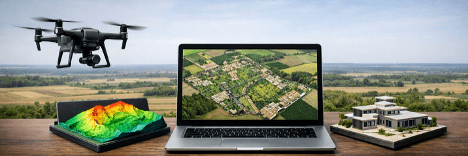
An orthomosaic is a high‑resolution, georeferenced map composed of hundreds or thousands of images stitched together. Unlike simple panoramas, orthomosaics correct for perspective distortions, ensuring that every point is positioned accurately on a two‑dimensional plane. You can zoom in to inspect small features, measure distances and areas, and overlay other GIS layers for deeper analysis.
Digital surface model (DSM) & digital elevation model (DEM)
A digital surface model (DSM) represents the earth’s surface with all features included—buildings, trees and other structures. A digital elevation model (DEM) (often called a digital terrain model, DTM) depicts the bare earth, with vegetation and structures removed. DEMs are essential for calculating slopes, drainage patterns and planning earthworks. DSMs are useful for visualizing how structures interact with the surrounding landscape and for performing cut‑and‑fill calculations.
3D textured model
When photogrammetry software triangulates matching points across multiple images, it can build a 3D mesh of the scene and apply texture maps to create a lifelike digital twin. These models allow clients to view their site from any angle, inspect complex structures and even generate point clouds. In construction, 3D models support clash‑detection and coordination between trades; in real estate, they provide immersive marketing visuals.
LiDAR point clouds
LiDAR (Light Detection and Ranging) sensors emit laser pulses and measure the time it takes for each pulse to return. Unlike photogrammetry, LiDAR can penetrate vegetation to capture the bare earth and provides highly accurate elevation data in areas with low texture or poor lighting. Deliverables include point clouds, which are collections of millions of 3D points, as well as derived DSMs and DTMs. New integrated payloads like DJI’s Zenmuse L2 combine LiDAR with an inertial measurement unit (IMU) and camera to deliver 240 000 points per second and horizontal/vertical accuracies of 5 cm and 4 cm at 150 m range.
Combining photogrammetry and LiDAR
Photogrammetry and LiDAR each have strengths. Photogrammetry produces high‑fidelity imagery and is excellent for visual inspections, while LiDAR excels in capturing accurate elevations under vegetation or in low‑texture areas. By merging the two, you can obtain a detailed textured mesh with survey‑grade accuracy—a valuable deliverable for engineering, mining and environmental projects.
Best practices for accurate mapping
- Plan your flight for high overlap. Strong image overlap (70–80 % or higher) and consistent flight altitude enable centimeter‑level accuracy. Maintain a regular grid pattern and avoid sudden altitude changes.
- Use GNSS corrections. Equip your drone with Real‑Time Kinematic (RTK) or Post‑Processed Kinematic (PPK) GNSS receivers to reduce positional error. For projects requiring survey‑grade accuracy, set ground control points (GCPs) throughout the site.
- Consider lighting & weather. Shoot on overcast days or when the sun is high to minimize shadows. Avoid windy conditions that can blur images or cause flight instability.
- Calibrate your sensors. If using LiDAR, perform boresight calibration and verify the accuracy of your IMU and camera alignment. Check manufacturer specifications—DJI’s Zenmuse L2 offers integrated calibration for ease of use.
- Process data carefully. Use reputable photogrammetry software and follow workflow checklists: align images, build dense point clouds, generate meshes, create orthomosaics and DEMs, and perform quality control.
How Blue Nose Aerial Imaging adds value
At Blue Nose Aerial Imaging, mapping isn’t just an add‑on—it’s part of our core expertise. Our services can integrate volumetric analysis, topographic & 3D modeling, thermal/multispectral imaging, and comprehensive processing and reporting. We can deliver cut‑and‑fill calculations to help earth‑moving contractors, 3D models for BIM coordination and thermal inspections to reveal hidden defects.
Flights are conducted safely and efficiently. Clients appreciate receiving regular progress updates without setting foot on site—an advantage made possible by remote progress monitoring. Our nationwide network ensures consistency across projects and allows us to mobilize quickly.
Real‑world results
Our clients’ testimonials speak for themselves. When one university needed five campuses—approximately 200 acres—mapped within a tight deadline, Blue Nose delivered all orthomosaics and elevation models in just four days. The project team was able to visualize assets, plan improvements and share clear documentation with stakeholders. Similar success stories come from construction managers who use our volumetric models for stockpile measurements and farmers who rely on our vegetative indices for precision agriculture decisions.
Final thoughts
Drone mapping unlocks a wealth of data products that were once accessible only to major engineering firms. By understanding the differences between orthomosaics, DSMs/DEMs, 3D models and LiDAR point clouds—and by following best practices—you can produce maps that are both visually compelling and technically precise.
At Blue Nose Aerial Imaging, we combine cutting‑edge technology with professional pilots to ensure that each mapping mission delivers actionable insights. Whether you need a detailed topographic survey, a volumetric analysis or a textured 3D model, our team is ready to help. Contact us today to learn how drone mapping can bring clarity to your next project.